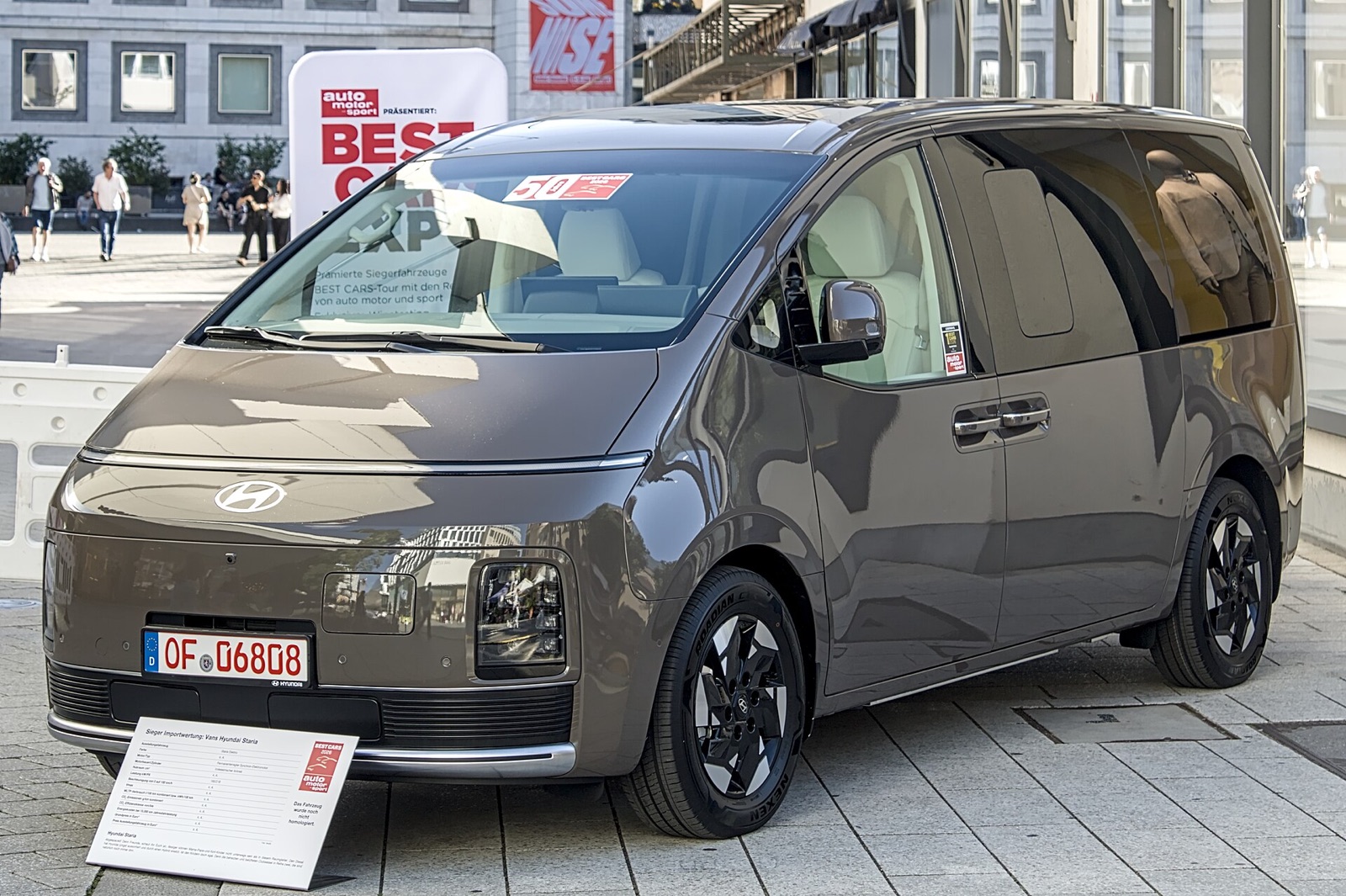
Hyundai Motor Deutschland opened order books for the STARIA Electric, the company’s first battery-electric people-mover, from 3 September. The nine-seat Trend starts at €57,450, the nine-seat Prime at €63,650, and the seven-seat Calligraphy at €66,950, according to Hyundai’s German press release and the MY27 price list. Those euro figures are German list prices, not a United Kingdom RRP and not a dollar sticker. Electrek restated the European order window on 17 September. This is a battery van — there is no petrol engine to fall back on — so it belongs with the battery-electric list, not on the plug-in hybrid list.
The German sheet is consistent across those three trims: an 84 kWh battery, a 160 kW (218 PS) front motor, and a claimed WLTP range of up to 430 km, with combined energy use of 21.8 kWh/100 km. Hyundai says an 800-volt architecture can take the pack from 10 to 80 percent in about 20 minutes under the conditions in that press note. Europe’s model page adds an 11 kW AC onboard charger. Towing is quoted at 2,000 kg braked, payload at 750 kg, and the nine-seater’s luggage volume at up to 1,303 litres plus a 24-litre frunk. Heat pump and battery heating are standard on the Trend. We are not converting 430 km into miles and then mixing that number with the UK page.
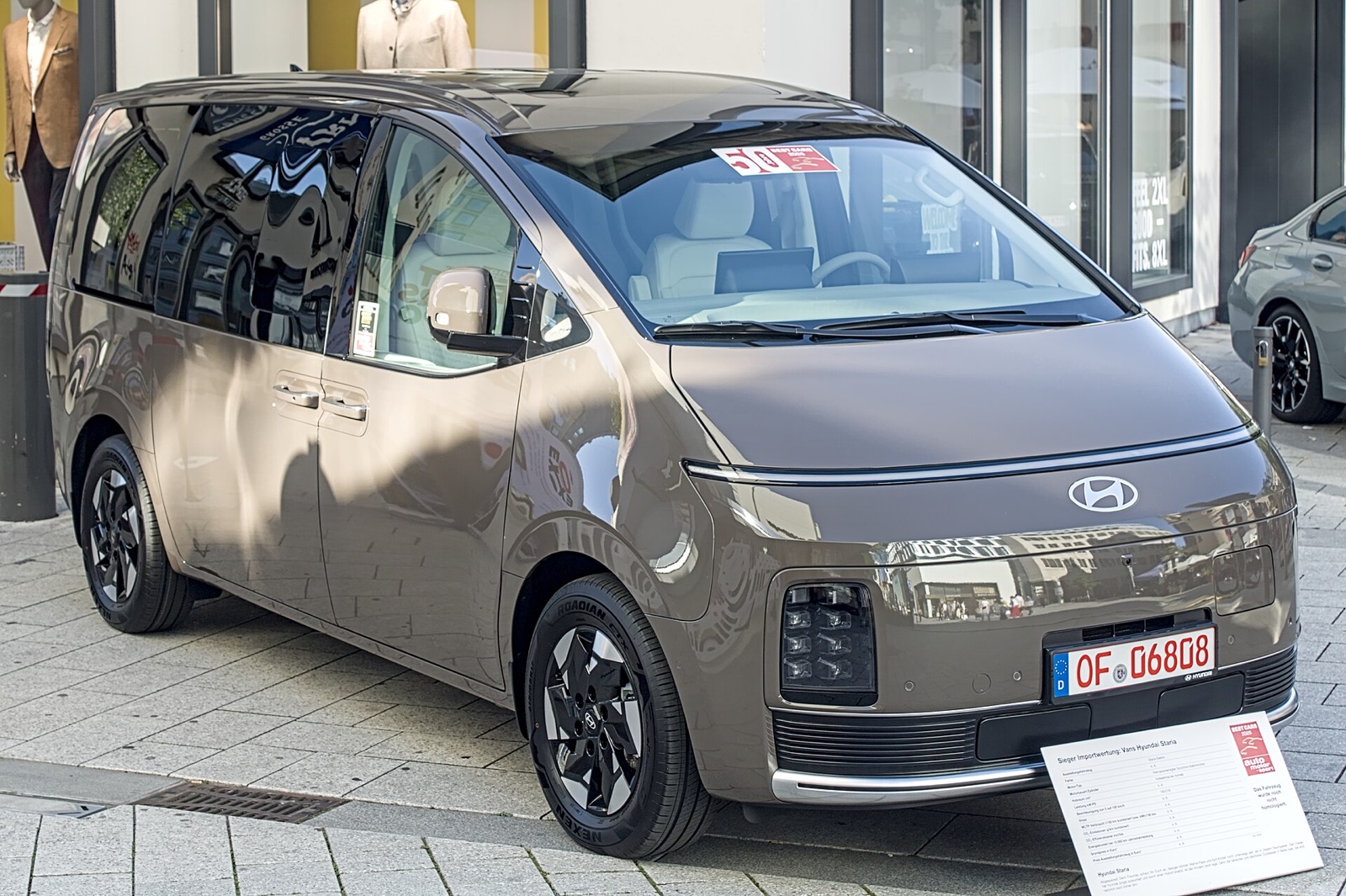
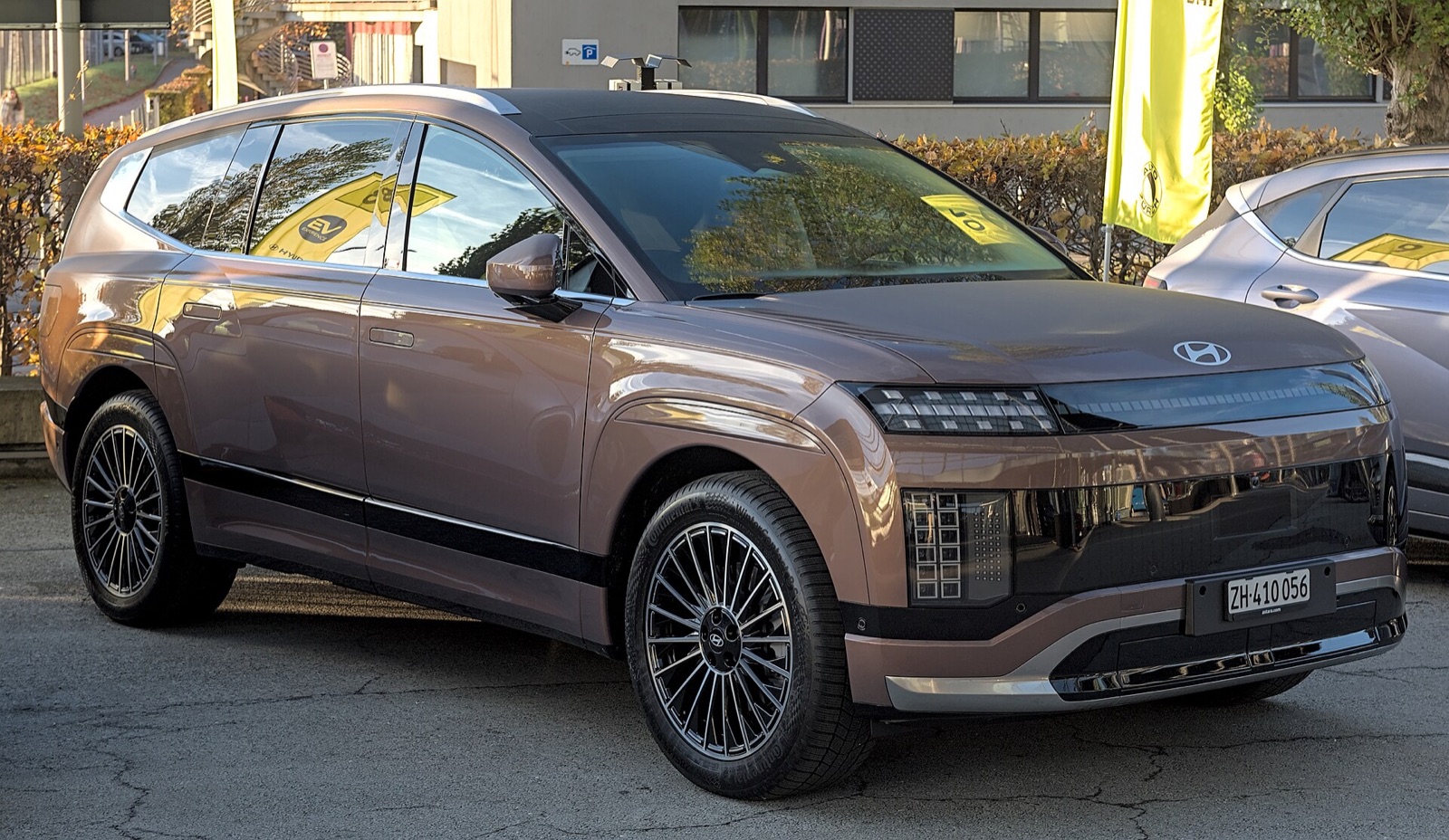
Hyundai’s UK site already has a STARIA Electric page. It quotes up to 248 miles of driving range and the same 84 kWh pack, and it offers 7- or 9-seat layouts. It does not publish a pound price we can audit, and “UK specification may vary” is on the page, so we are not inventing a UK OTR figure or treating 248 miles as the German 430 km claim in another unit. Shoppers comparing Hyundai battery cars on this directory should start on the Hyundai hub. The van’s own card is the STARIA Electric (2027) — 84 kWh, 430 km WLTP, United Kingdom Announced. The closest three-row sibling already live is the IONIQ 9 (2026) — 110.3 kWh, 620 km, 350 kW DC on the live card, United States Available, United Kingdom Announced. That page is an SUV, not a van. The 800-volt family car already sold in all three of our markets is the IONIQ 5 (2026) — 80 kWh, 546 km, 260 kW DC, UAE, US and UK Available. The compact hatch Hyundai is bringing to Europe is the IONIQ 3 (2026) (61 kWh, 496 km, UK Announced). None of those three pages is the STARIA.
If the job is a sliding-door MPV rather than a tall SUV, the live catalogue already has the Volkswagen ID.Buzz (2025) under vans and MPVs: 86 kWh, 377 km, 200 kW DC, United States and United Kingdom Available. Carscoops, covering the German STARIA ladder, put a long-wheelbase ID.Buzz Pro with an 86 kWh pack a few hundred euros above the STARIA Trend in that market. That is Carscoops’ German comparison, not a UK or US invoice. Hyundai has not listed the STARIA Electric for the United States or the UAE in the materials we used; Electrek made the same US point. We are not claiming either market.
Hyundai’s plug-in hybrids stay a different shopping list. The Santa Fe Plug-in Hybrid (2026) is a petrol-electric SUV, UK Available, 13.8 kWh and about 54 km electric on the live card. The Tucson Plug-in Hybrid (2026) is the smaller US-available sibling on the same 13.8 kWh pack (53 km electric). Neither is a van, and neither is “an electric car.” What we are not claiming: a UK or UAE STARIA price; a US on-sale date; that 248 miles equals 430 km; or that the STARIA pack is the IONIQ 5 pack. Li Auto’s i9 six-seat battery SUV, launched in China on 16 September at 369,800 yuan, is a separate China story — the live Li Auto card remains the Mega (2025) MPV (UK Announced), not an i9.