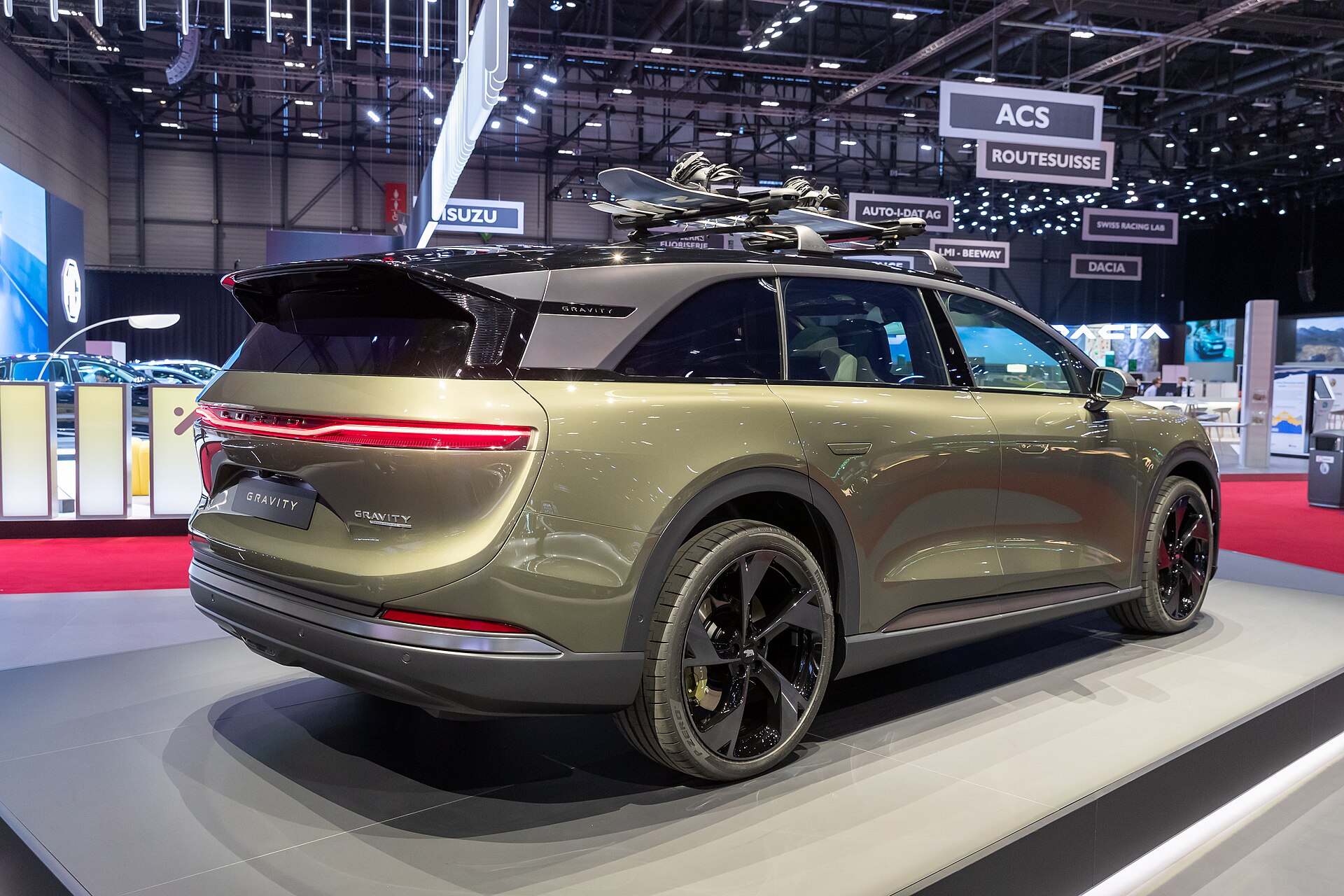
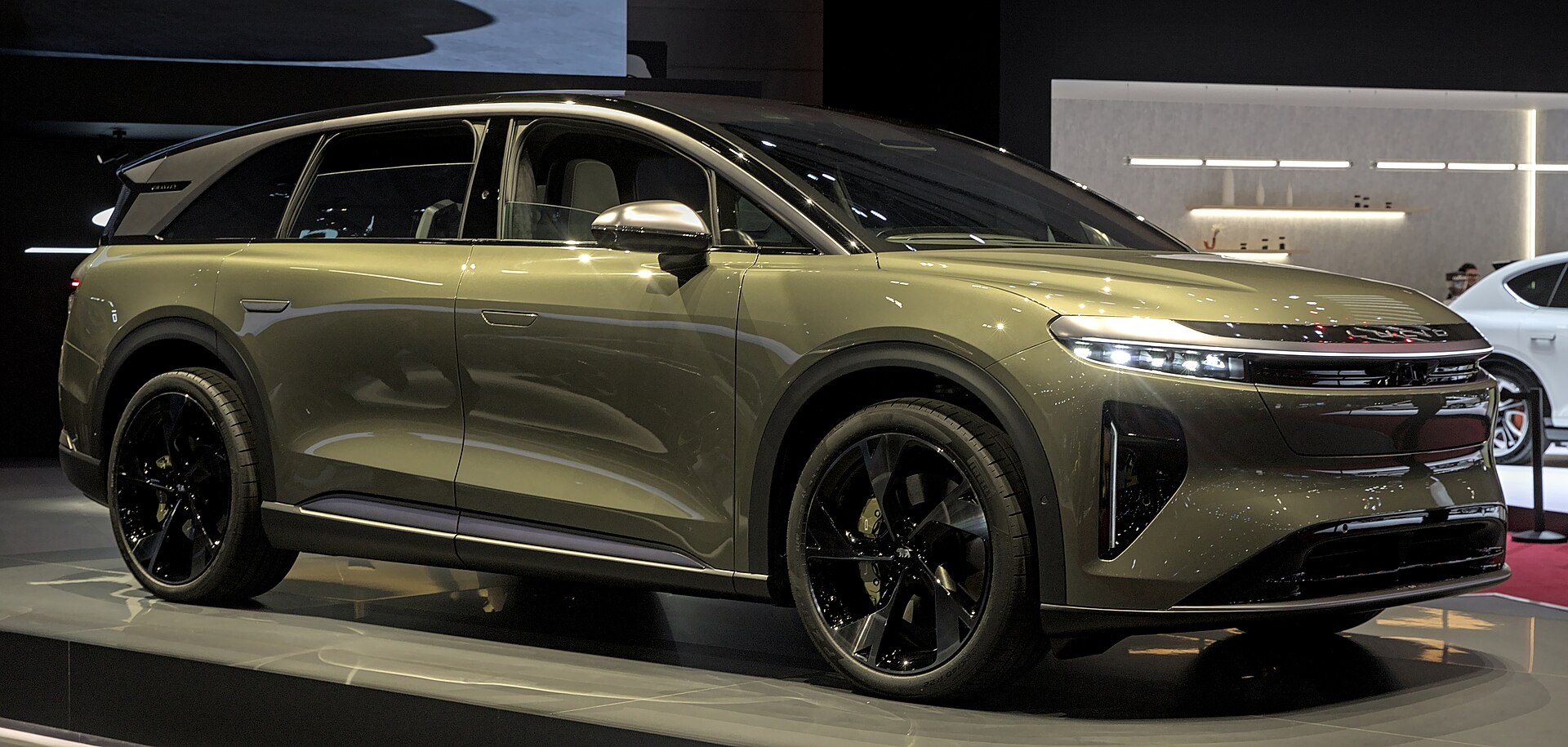
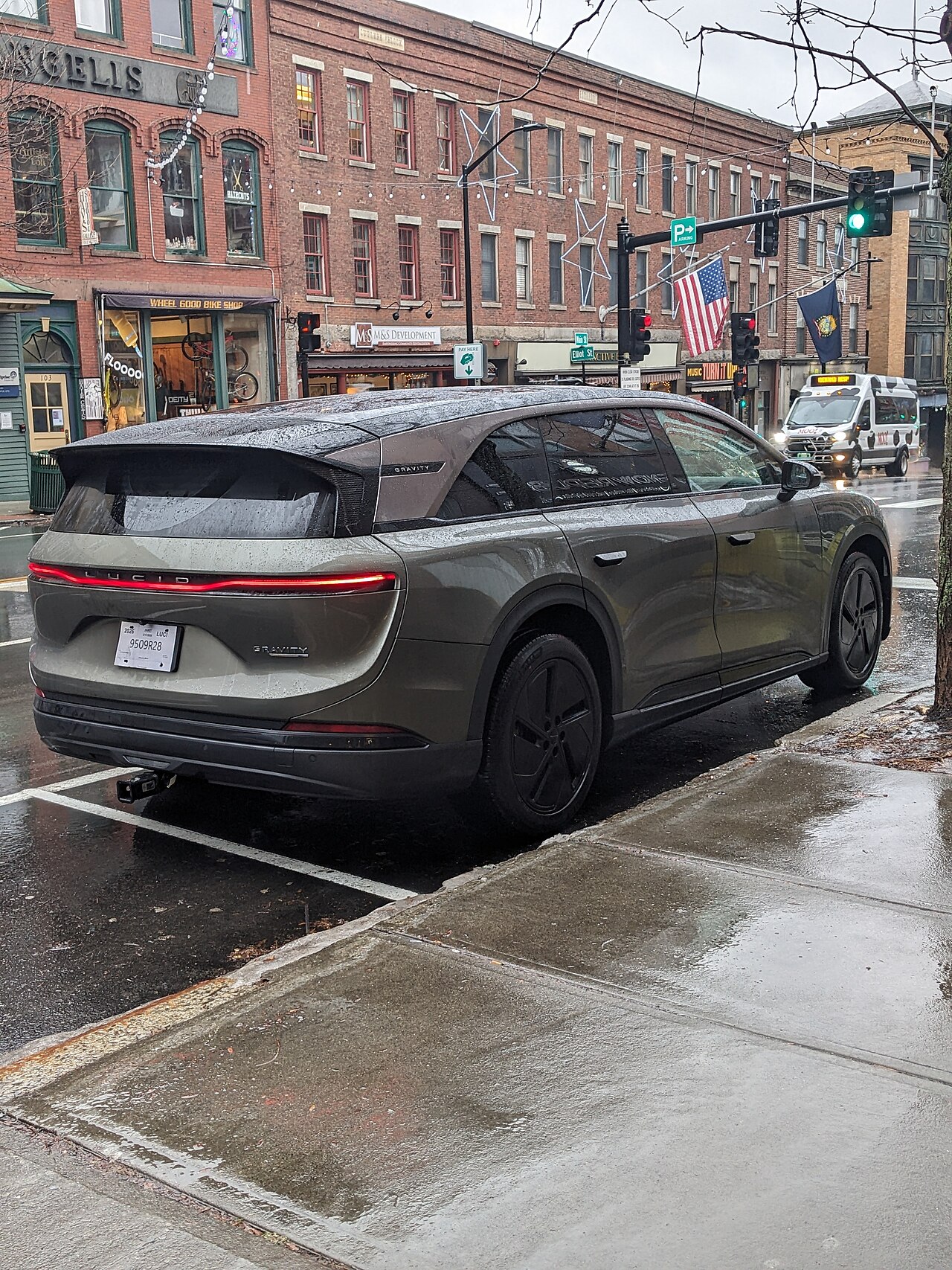
Lucid used Monterey Car Week to put a production-intent performance Gravity on the Concours Village lawn at Pebble Beach, next to the Air Sapphire. The new trim is the Gravity GT-S: a dual-motor, all-wheel-drive three-row SUV that Lucid rates at 1,070 horsepower and a 3.1-second 0–60 mph run. Orders are open now, and the company says the car will be sold only in the United States.
That US-only line is the part that matters for shoppers on GetEVCar. The 2026 Gravity is already listed for the American market; UAE availability has been announced rather than broadly retailed. GT-S does not change that map. Lucid’s 13 August release, carried on its investor site and PR Newswire, is explicit: exclusive to the United States, priced from $125,900 before tax, title, options, and a $1,850 destination fee. A Tahoe leather cabin is listed at $1,300. Car and Driver added those two line items and called the drive-away start $127,750—the same arithmetic, not a second MSRP.
The GT-S is not a new powertrain. Electrek and Car and Driver both describe it as the successor to the Gravity Dream Edition, using the same two-motor stack. Car and Driver’s instrumented 2026 Dream Edition already hit 3.1 seconds to 60 mph, so the GT-S number is a manufacturer claim that matches a test they have already run on closely related hardware—not an independent GT-S result. The 1,070 hp “America’s most powerful three-row SUV” phrasing is Lucid’s marketing line; it is not a third-party ranking.
What does change versus a Grand Touring is the standard chassis kit and the sticker. Lucid’s Gravity GT-S page lists Grand Touring from $98,900 and Touring from $79,900 for the 2027 model year. Electrek put the GT-S premium at about $27,000 over Grand Touring. Car and Driver noted that the last Dream Edition it tested started at $141,550, so the GT-S undercuts that halo by roughly $14,000 once destination is included. Rear-wheel steering and an adaptive three-chamber air suspension—Lucid’s Dynamic Handling Package—are standard on GT-S, not a paid extra.
Design is where Lucid is trying to make the trim read as a sibling of Sapphire rather than a leftover Dream Edition. The release describes blue exterior accents, blue-painted calipers, Mojave PurLuxe with blue stitching and seatbelts, and the Lucid bear embossed in the front headrests. Chief creative officer Derek Jenkins called it “a more expressive and exhilarating interpretation of the Gravity SUV.” Electrek separately listed five-seat as standard, a $2,900 seven-seat option, Abyss Black with Stealth Appearance as the no-cost paint, and $1,000 metallic upgrades; those option prices are not in the PR Newswire text, so treat them as Electrek’s configurator readout until Lucid publishes a full order guide.
Range is the trade Lucid is asking performance buyers to accept. On the same comparison table, Grand Touring is listed at up to 450 miles EPA; GT-S is a projected 373 miles. That is a manufacturer projection, not a published EPA window sticker. Charge-to-200-miles times on the same page (14 minutes for GT-S, under 11 for Grand Touring) are likewise Lucid figures. Anyone comparing the Lucid lineup should wait for certified labels before treating 373 miles as a shopping spec.
Timing is slightly messy across sources. Lucid’s GT-S product page says “available late 2026.” Electrek reported a fourth-quarter 2026 window. Car and Driver wrote that Lucid had not confirmed when deliveries begin. Until a retailer or Lucid names a first-customer month, late 2026 is guidance, not a locked start of production.
For GetEVCar readers, the takeaway is narrower than the Monterey staging. If you are shopping a three-row luxury EV in the US, Gravity now has a named performance rung with a public price and a handling package included. If you are shopping in the UAE or UK, this trim is not on the table; watch the existing Gravity and Air pages instead of waiting for a GT-S allocation that Lucid has already said will not ship overseas.