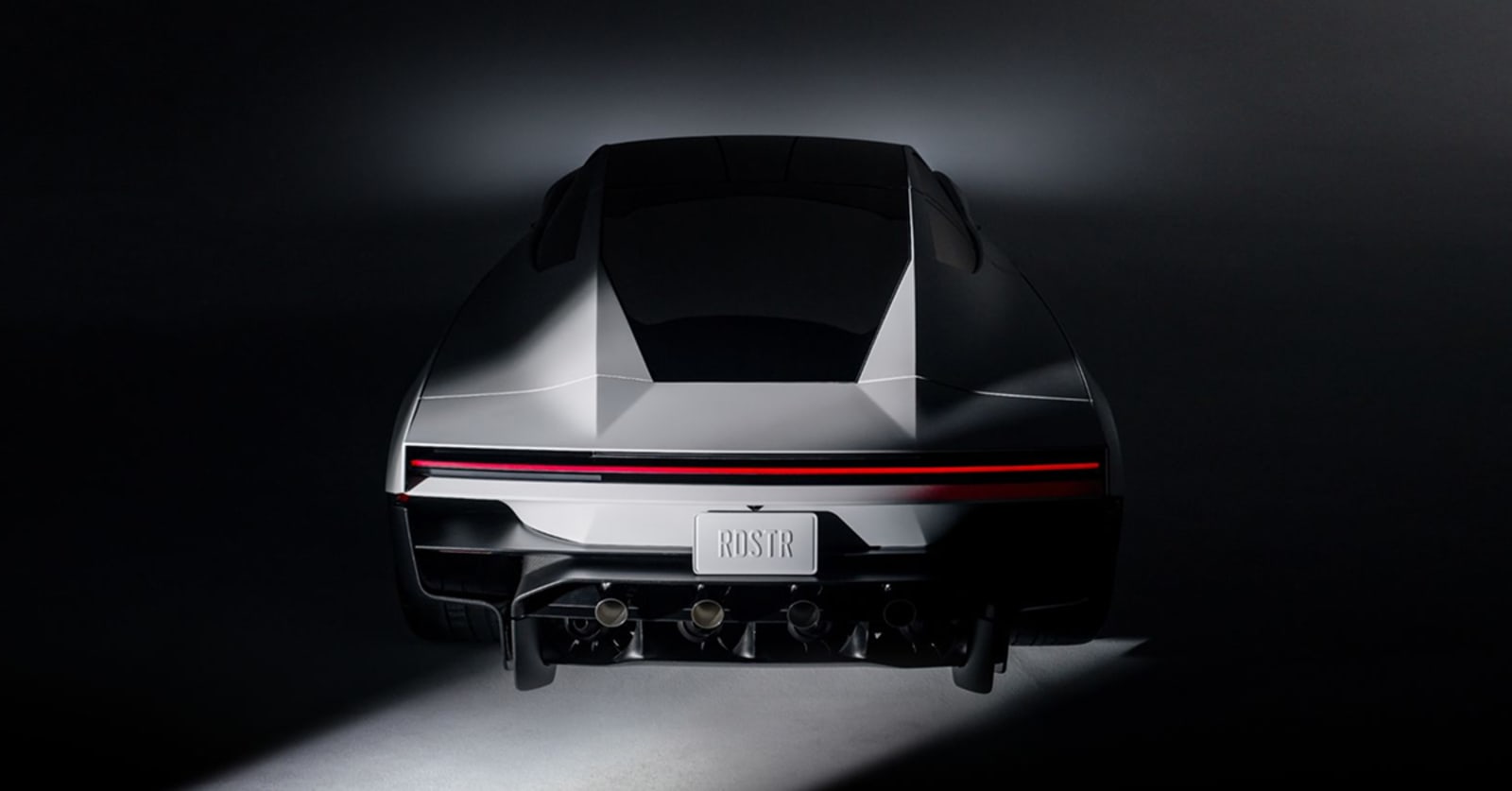
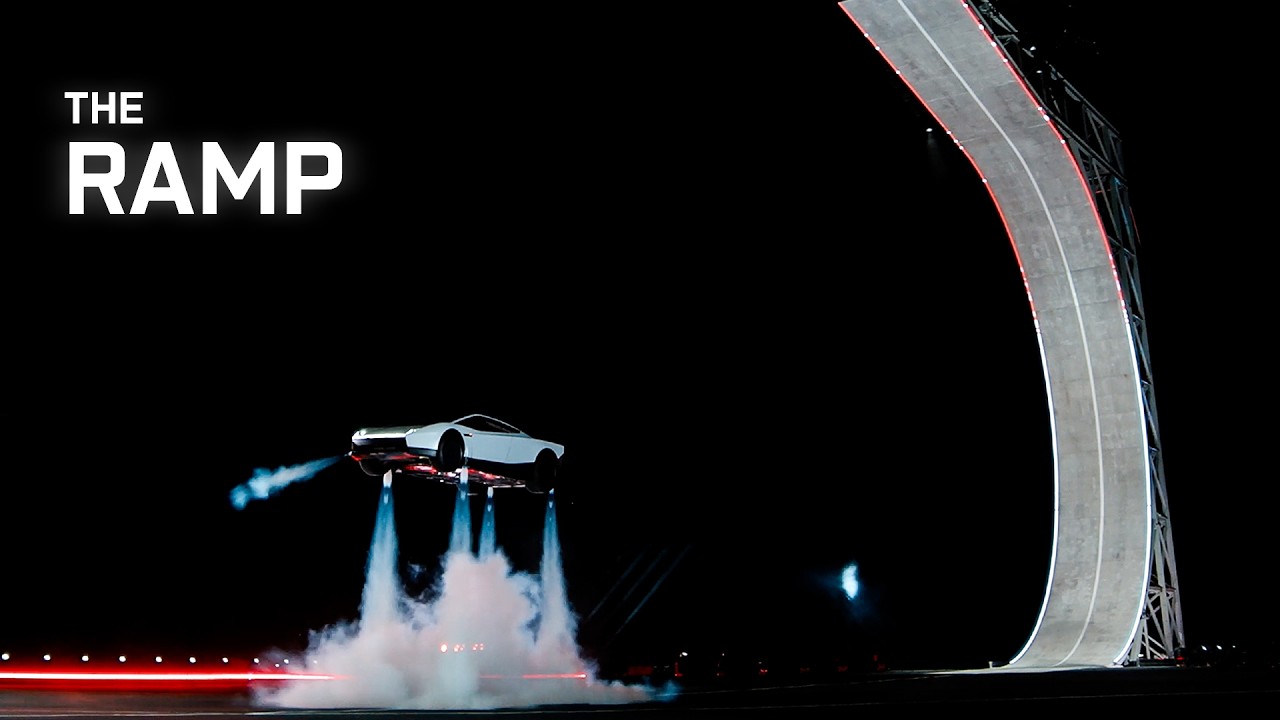
On the night of 15 October 2026, Tesla ran a second-generation Roadster prototype at SpaceX’s rocket development site in McGregor, Texas. The company livestreamed the demonstration and, the next day, posted a 23-minute replay on its own YouTube channel under the title “Roadster Event.” Reuters, Car and Driver, and WIRED all covered the same night: a white car drove up a curved ramp on an underbody fan, kept going while inverted, then used cold-gas thrusters to roll and land. A later pass left the ground again and cleared other Tesla vehicles.
Tesla first showed a next-generation Roadster in 2017 and, at the time, talked about deliveries in 2020. The McGregor night is the first public running of a car that actually left the pavement. Elon Musk told the crowd that production would start in 2028. Reuters, Car and Driver, and WIRED each reported that line. It is a statement from the stage about when Tesla intends to build the car. It is not a confirmed delivery slot.
What the prototype did
Reuters described the sequence as an upside-down run on a suction system, a turn in the air, a thruster landing, and then a jump over a truck and other vehicles. Car and Driver, whose reporter was at the site, called the ramp a tall outdoor arch and wrote that SpaceX-supplied thrusters rolled the car before it settled in a cloud of vapor. That outlet also reported Tesla’s figure for the thrusters as more than 80 kilonewtons. Reuters and WIRED did not publish that force number, so it stays a single-outlet account of what Tesla said, not a measurement from a third-party test.
Tesla’s own description on the full replay splits the night into chapters: ramp demo from about 6:03 to 10:55, a kickflip from 10:56 to 12:43, design from 12:47 to 14:38, aero from 14:38 to 15:57, and the acceleration runs from 15:58 to 19:26. In the opening of that replay, the presenters say the stunt passes are being driven autonomously so that nobody is in the car for the flying maneuvers. Musk, in Car and Driver’s account of the same evening, still described the Roadster as a car an owner would drive, and as the company’s long-term manually driven model.
The full replay is Tesla’s recording, embedded below. A second official clip, “The Ramp,” is the short version of the inverted pass.
Three configurations, and a footnote worth reading
Tesla’s Roadster page now describes three configurations. The names below are Tesla’s. The hardware assigned to each one is less tidy than the labels, because the page attaches an important footnote to the most extreme claims.
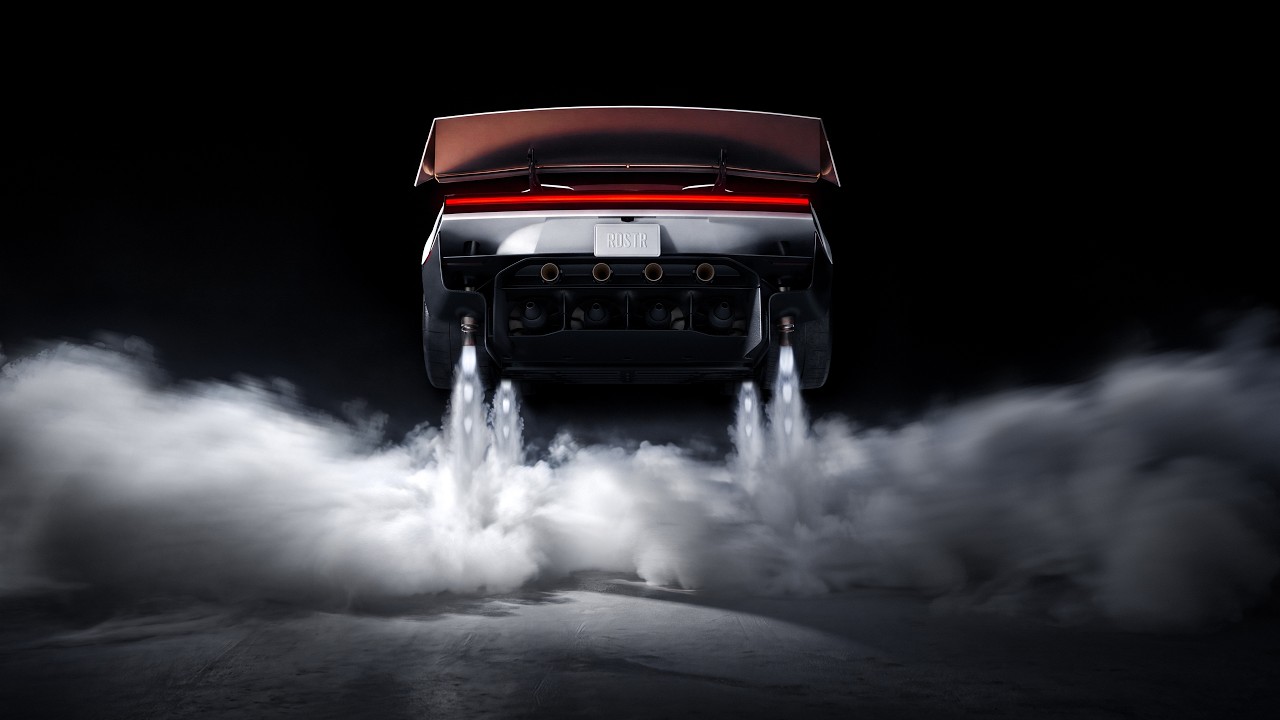
Performance is the version Tesla marks as open for reservation. It seats two. Tesla says it includes active aerodynamics and a multi-mode fan meant to generate downforce, including enough suction to hold the car upside down while it is sitting still. Thrust is labeled a limited release, also with two seats. Tesla says it adds cold-gas thrusters at the rear and that those thrusters take the car from 0 to 60 mph in under one second. Rocket is invite-only and seats one. Tesla says thrusters around the edge of the car can push it forward, upward, and through a sideways rotation. Under that Rocket description, Tesla states that the vehicle is not approved for public road use.
The same product page marks the upside-down suction passage and the in-flight stabilization passage with a footnote: available on the Rocket trim only, and not in every region. A separate line says the specifications on the page reflect the Thrust package and are an optional upgrade. Read together, Tesla has published a trim list and, in the same breath, told readers that the headline physics may be limited to one invite-only variant. Until a build sheet assigns each feature to one car, the page is the company’s product copy, not an independent spec confirmation.
Car and Driver, watching the livestream, reported butterfly doors, a two-seat cabin, a yoke, and a wide horizontal screen on the car that came on stage. The outlet also wrote that the flying car and the stage car wore different wheels, so the night used more than one prototype. The thrusters, in that account, are fed by high-pressure air tanks the car can refill itself, rather than by jet fuel. Tesla’s product page calls the same hardware cold-gas thrusters with electric actuators.
Acceleration, speed, range, and money
Tesla’s own clip “The 0-60” puts 0.81 seconds on the title card. Car and Driver described two claimed runs at McGregor, the first around one second and the next about 0.8 seconds, both with the rear thrusters working. Reuters quoted vehicle engineering chief Lars Moravy saying the car can reach 60 mph in less than one second and can exceed 230 mph (370 km/h). In that same Reuters account, Musk answered that it should be faster, and that the target should be halfway to the speed of sound. WIRED reported the same split: Moravy hoping for about 230 mph, and Musk talking about a much higher figure. No outlet published an independent timing slip or a certified top-speed run. These are Tesla’s demonstration claims, repeated by reporters who watched.
Range sits in the same bucket. Reuters and WIRED both reported a figure above 300 miles (about 480 km) on a charge. Reuters noted that this is less than half the range Tesla discussed in 2017. That older target was not restated on 15 October, so it is left out of this article. The product page checked for this story did not print a battery size in kilowatt-hours or a charge rate.
Tesla also left the purchase price unstated. Reuters noted that the company quoted a base price of $200,000 almost ten years ago and did not replace it with a new price on Thursday. What the US site will take now is a reservation. On Tesla’s US reservation page, checked 18 October 2026, the two-seat “road ready” configuration shows $5,000 due today, marked fully refundable, and $45,000 due within 10 days. The page says the reservation is cancelled if that second payment misses the window. Reuters reported the Performance total as a $50,000 deposit and the Thrust version, the one with acceleration thrusters, as a $250,000 deposit. WIRED described those same totals as $5,000 upfront plus the balance inside 10 days: $45,000 more for Performance, and $245,000 more for Thrust. Rocket remains invite-only in Tesla’s copy and in both reports. Those sums are deposits. A sticker price for the car is still unpublished.
What a buyer can use today
Musk’s line on stage, reported by both WIRED and Car and Driver, was short: “This is not necessarily a safety-optimized car.” Car and Driver also reported that he said he was unsure the car would be legal in every jurisdiction, while still expecting that someone would be able to own one. Tesla’s Rocket note on its own site is more specific: that version is not approved for public road use. None of this is a crash-test result or a regulator’s ruling. It is the company, and its chief executive, describing a prototype demo.
Shoppers comparing Teslas that already have pages on GetEVCar are looking at other cars. The Tesla brand page is the catalog index. The Model Y Long Range is one of the volume models with a live listing. The demonstration was in Texas, and the deposit figures above are from Tesla’s US reservation page, so the US market page is the on-site starting point for what is listed in that country. Reuters framed the Roadster night against Tesla’s heavier emphasis on autonomy and robotics, including the Cybercab. GetEVCar’s earlier note on the reopened reservation page covered the deposit before this demonstration. The new facts are the running car, the thrusters, the three-way trim split, and a 2028 production claim with no purchase price attached.
Sources: Tesla, “Roadster Event,” “The Ramp | Roadster,” “The 0-60 | Roadster,” and “Roadster | The Last Best Driver’s Car” on the Tesla YouTube channel, plus the Roadster product page and the US reservation page (checked 18 October 2026). Reuters, 15–16 October 2026. Car and Driver, updated 16 October 2026. WIRED, 15 October 2026.