
The automotive landscape of the United Arab Emirates is currently navigating a pivotal transition point, shifting from a market defined by high-performance internal combustion luxury to one centered on sustainable, high-technology mass mobility. This evolution is not merely a consumer trend but a structural realignment driven by the UAE Net Zero 2050 Strategic Initiative and the Dubai Green Mobility Strategy 2030.1 As the nation approaches 2026, the arrival of a new generation of affordable electric vehicles (EVs) is expected to decouple sustainable transport from its historical premium price tag, making zero-emission driving accessible to the broader population. The following report provides an exhaustive analysis of the market dynamics, model forecasts, infrastructure scaling, and economic variables that will define the affordable EV sector in the UAE through 2026.
The Regulatory Framework and National Vision for Electrification
The acceleration of the electric vehicle market in the UAE is anchored in a robust regulatory framework that integrates federal goals with emirate-level execution. The National Electric Vehicles Policy, issued in 2023 by the Ministry of Energy and Infrastructure, serves as the primary roadmap for this transition.4 The policy objectives are multi-faceted, focusing on mitigating climate change by reducing carbon emissions in the transport sector, fostering domestic industrial growth, and regulating the infrastructure for charging stations.4 A critical target set by the government is to have at least 10% of all vehicles on UAE roads be electric by 2030, with some projections aiming for 50% penetration by 2050.5
Incentives have been a primary lever for adoption. In Dubai, the Roads and Transport Authority (RTA) and the Dubai Electricity and Water Authority (DEWA) have implemented a suite of benefits including free public parking in designated green zones, free Salik (toll) tags for newly registered EVs, and reduced registration and renewal fees.8 These measures directly lower the barrier to entry for budget-conscious buyers. Furthermore, the Dubai Autonomous Transportation Strategy aims for 25% of all transportation to be autonomous by 2030, a goal that is inextricably linked to the rollout of electric taxi and bus fleets.7
Comparative Overview of Government Incentives and Policies
| Emirate / Entity | Incentive Type | Scope and Duration | Strategic Goal |
| Federal (MOEI) | National EV Policy | Roadmap for 50% EV target by 2050 | Unified standards and market regulation 4 |
| Dubai (RTA) | Salik Exemptions | Free tag for new registrations | Reduce initial setup costs for owners 8 |
| Dubai (RTA) | Free Public Parking | Designated green-painted spaces | Daily operational savings for urban commuters 9 |
| Dubai (DEWA) | Green Charger Initiative | Reduced tariffs and streamlined billing | Expand public accessibility to over 1,500 points 2 |
| Abu Dhabi (DoE) | EV Charging Tariffs | Standardized 2021 rates | Predictability for residential and commercial users 2 |
| Abu Dhabi (ADNOC) | E2GO Joint Venture | Target of 70,000 charging points by 2030 | High-speed highway and residential coverage 2 |
| Commercial Banks | Green Auto Loans | Lower interest rates for EVs/Hybrids | Financing accessibility for entry-level buyers 6 |
The Current State of the Affordable EV Market (2024–2025)

As of late 2024 and early 2025, the UAE has already seen a significant influx of affordable electric models, primarily from Chinese manufacturers who have successfully scaled production to offer high-specification vehicles at competitive price points. The market value, estimated at USD 780.65 million in 2024, is witnessing its fastest growth in the compact SUV and sedan segments, driven by rising fuel prices and a growing secondary market.3
Brands such as BYD, Geely, and MG have established themselves as the “value kings” of the region. The Geely EX5, for instance, has become a benchmark for urban professionals, offering a 60.22 kWh battery and a range of up to 430 km for under AED 100,000.14 Similarly, the BYD Atto 3 has gained widespread popularity due to its robust Blade Battery technology and a feature-rich interior that includes a rotating 15.6-inch touchscreen.15 These vehicles are not merely functional; they are tech-forward, appealing to a demographic that values digital integration as much as mechanical reliability.
Leading Affordable EVs Currently in UAE (Sub-AED 150,000)
| Model | Starting Price (AED) | Range (WLTP/CLTC) | Key Performance Specs |
| Hyundai Kona Electric | 76,999 | 480 km | 201 hp; high resale value 15 |
| MG ZS EV | 94,000 | 335 – 440 km | 174 hp; family-friendly SUV 8 |
| JAC E30X | 98,800 | 400 km | 134 bhp; tailored for city driving 16 |
| Volvo EX30 | 99,900 | 476 km | 0–100 km/h in 3.6s (Performance trim) 16 |
| BYD Atto 3 | 109,900 | 420 – 510 km | 201 hp; Blade Battery safety 15 |
| MG4 | 102,000 | 530 km | 150 kW variant; minimalist interior 16 |
| Geely Geometry C | 140,000 | 450 – 485 km | 201 hp; smart tech integration 8 |
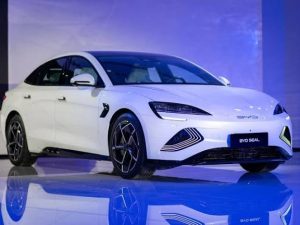
| BYD Seal | 149,900 | 570 km | Premium sports sedan; cell-to-body tech 16 |
Forecast 2026: The New Wave of Mass-Market Electric Vehicles
The year 2026 is projected to be a transformative era for affordable mobility in the UAE, characterized by the arrival of “mainstream” budget models from global giants and the maturation of second-generation Chinese EVs. The forecast suggests a decisive shift toward 800-volt architectures and longer-range LFP batteries even in entry-level segments, effectively neutralizing range anxiety for inter-emirate travel.14
The Entry of the Tesla “Model 2” and Compact Rivals
One of the most anticipated developments is the rumored Tesla Model 2 (or Tesla Compact), expected to bring the brand’s sophisticated software and Supercharger access to a price point near AED 90,000 to AED 110,000.23 This model is likely to become a volume driver in the UAE, appealing to first-time EV buyers who prioritize ecosystem reliability over raw luxury. Concurrently, Kia is set to launch the EV3 and EV4, which utilize the proven E-GMP platform but with a 400-volt architecture optimized for cost-efficiency.24 The EV3, a compact SUV, is expected to offer over 480 km of range for approximately AED 130,000, while the EV4 targets the electric sedan segment with a focus on aerodynamics and minimalist design.24
Xiaomi and the Tech-Giant Disruption
The automotive unit of Xiaomi is expected to play a critical role in 2026 through the introduction of the SU7 and YU7 models. While initially launched in China, parallel import channels in the UAE are already preparing for a 2026 surge.29 The facelifted 2026 Xiaomi SU7 is rumored to adopt a 900V platform, enabling ultra-fast 5C charging that could reposition it as a superior alternative to traditional luxury sedans at a mass-market price.22 This represents a broader trend where vehicles are increasingly marketed as “smart devices on wheels,” integrating deeply with a consumer’s existing digital life.29
Anticipated 2026 Mass-Market EV Launches
| Model | Estimated Arrival | Target Price (AED) | Forecasted Impact |
| Kia EV3 | Jan 2026 | 130,000 – 150,000 | Record-breaking sales in compact SUV segment 26 |
| Tesla Model 2 | Mid-2026 | 95,000 – 110,000 | Gateway for mainstream Tesla adoption 23 |
| BYD Atto 3 (Update) | Mid-2026 | 130,000 | Range boost to 650 km via 74.88 kWh battery 34 |
| Omoda C7 | Q1 2026 | 128,000 | Mid-range crossover with 800V support 35 |
| Rivian R2 | Late 2026 | 165,000 | Adventure-focused SUV at a lower price point 35 |
| Xiaomi SU7 (Facelift) | Q2 2026 | 135,000 – 160,000 | Disruption of the executive sedan segment 22 |
| Wuling Bingo | 2026 | 45,000 – 65,000 | Lowest entry point for urban-only transport 40 |
Infrastructure Maturation: The National EV Charging Network
A key enabler for the 2026 affordable EV surge is the rapid expansion of the UAE’s charging ecosystem. The “National EV Charging Network” (NEVCN) initiative ensures that the infrastructure keeps pace with vehicle sales, specifically targeting the reduction of range anxiety for those living in apartments or working in commercial districts.1
Strategic Partnerships and Mega-Rollouts
In Abu Dhabi, the joint venture E2GO is a cornerstone of the 2030 vision, with industry projections suggesting a need for 70,000 charging points by the end of the decade.2 For 2026, the focus is on deploying hundreds of high-speed chargers along major transit corridors like the E11 and E311, facilitating seamless travel between Abu Dhabi, Dubai, and the Northern Emirates.9 Dubai, under DEWA’s “Green Charger” initiative, has already reached over 1,270 stations, with plans to expand this by 170% as the number of registered EVs in the city is expected to surpass 42,000 by 2030.2
The technical specifications of the network are also evolving. While Level 2 AC chargers remain standard for residential and office settings, the 2026 landscape will feature a significantly higher density of 350 kW ultra-fast DC chargers.1 These units can charge a compatible EV to 80% in approximately 15 to 20 minutes, mirroring the convenience of a traditional fuel stop.1
Infrastructure Growth Projections (2023–2026)
| Region / Metric | 2023 Actual | 2025 Projected | 2026 Forecast |
| Total Public Stations (UAE) | 621 | 2,000 | > 3,500 9 |
| Dubai DEWA Points | 370 | 1,000 | 1,500 2 |
| Abu Dhabi Public Points | ~250 | ~1,200 | ~2,500 2 |
| 350kW Ultra-Fast Hubs | Pilot | 100 | 250 1 |
| Building Code Compliance | Pilot | 5% Allocation | 10% Allocation 2 |
Economic Analysis: Total Cost of Ownership (TCO) Comparison
For the budget-conscious buyer in the UAE, the transition to an EV is increasingly driven by hard economics. While the initial purchase price of an EV remains 10% to 20% higher than an equivalent petrol car, the Total Cost of Ownership (TCO) over a five-year period often favors the electric option.10
Operating Expenses: Fuel vs. Electricity
The daily operational savings of an EV in the UAE are substantial. With petrol prices for Special 95 hovering between AED 2.50 and AED 2.70 per litre, a typical internal combustion engine (ICE) vehicle costs roughly AED 0.25 to AED 0.35 per kilometer to fuel.44 In contrast, an EV charging at DEWA’s flat rate of 29 fils per kWh costs approximately AED 0.05 to AED 0.08 per kilometer.5 For a driver covering 20,000 km annually, this results in fuel savings of approximately AED 4,000 to AED 5,500 per year.10
Maintenance and Resilience
EVs possess significantly fewer moving parts than ICE vehicles, eliminating the need for oil changes, spark plug replacements, and complex transmission maintenance.10 Regenerative braking systems further extend the life of brake pads, with some owners reporting up to 50% less wear compared to traditional systems.10 On average, routine servicing for an EV is estimated to be 24% to 40% cheaper than for a petrol car.43
The Insurance Premium Challenge
Despite operational savings, insurance remains a point of friction. EV insurance premiums in the UAE are currently 20% to 35% higher than those for petrol cars, with some high-end models seeing a 72% gap.48 This is attributed to the high cost of replacement parts, specifically battery packs which can cost between AED 60,000 and AED 80,000, and a shortage of specialized repair workshops.48 However, as the market matures and more claims data becomes available, experts project that these premiums will stabilize by 2026 as insurers adopt data-driven models that account for battery health and driving patterns.13
Estimated 5-Year TCO: Affordable EV vs. Petrol Crossover
| Cost Category | Compact Petrol SUV (AED) | Affordable EV SUV (AED) | Net Difference |
| Initial Purchase Price | 85,000 | 105,000 | – 20,000 (EV Costlier) |
| Total Fuel/Energy (100k km) | 32,500 | 8,500 | + 24,000 (EV Saving) 10 |
| Scheduled Maintenance | 12,000 | 6,500 | + 5,500 (EV Saving) 10 |
| Registration & Renewal Fees | 4,500 | 0 (Waiver) | + 4,500 (EV Saving) 6 |
| Insurance Premiums (5 Years) | 18,000 | 26,000 | – 8,000 (EV Costlier) 48 |
| Salik Tag & Initial Fees | 600 | 0 | + 600 (EV Saving) 10 |
| Estimated 5-Year TCO | 152,600 | 146,000 | + 6,600 (EV Net Gain) |
Technological Considerations for the UAE Climate
The “August Threshold”—the period of extreme heat in the UAE—is a critical variable for EV performance. High ambient temperatures can reduce battery efficiency and increase the energy load of cabin cooling, which in turn reduces the vehicle’s real-world range by 10% to 15%.18
Thermal Management and Battery Chemistry
To combat these effects, manufacturers are increasingly adopting advanced thermal management systems and shifting toward Lithium Iron Phosphate (LFP) battery chemistry. LFP batteries, such as those used by BYD and Omoda, offer higher thermal stability and a longer lifespan under frequent deep-discharge cycles compared to traditional Nickel Manganese Cobalt (NMC) chemistries.18 These batteries are less likely to suffer from “wilt” during peak summer months, ensuring that budget EVs remain reliable primary vehicles for residents.18
Furthermore, the 2026 cohort of EVs will benefit from improved aerodynamics and more efficient heat-pump-based HVAC systems. The Geely EX5 and the Xiaomi SU7, for example, have prioritized low drag coefficients and intelligent climate control to maximize range during high-speed highway travel.14
The Industry Ecosystem: Dealers and Local Manufacturing
The shift toward affordable EVs is being championed by established UAE dealer groups who are reimagining the retail experience. Al-Futtaim Electric Mobility Company and AGMC have both launched “Discovery Centers” in major malls, moving away from traditional industrial showrooms to reach consumers in high-traffic retail environments.54 These centers focus on education, addressing common concerns about battery longevity and charging logistics.56
The Emergence of the “Emirati EV”
A significant milestone for 2026 is the maturation of domestic EV manufacturing. M Glory Holding Group is establishing a 1 million square foot factory in Dubai Industrial City to produce the “Al Damani” EV models.58 With a target price starting around AED 127,500 and a range of 405 km, these vehicles are built to European specifications but optimized for the local environment.20 The presence of a local manufacturer not only bolsters national pride but also ensures a more stable supply of spare parts and specialized service support, potentially lowering insurance and repair costs over time.48
Major Dealer Groups and Their 2026 EV Portfolios
| Dealer Group | Key Brand Partners | Strategic Focus |
| Al-Futtaim | BYD, Volvo, Polestar | 50% NEV sales target; mall discovery centers 55 |
| AGMC | Geely, Zeekr | High-value tech-first SUVs; rapid model refreshes 54 |
| Juma Al Majid | Hyundai, Kia | Mainstream reliability; launch of dedicated EV platforms 26 |
| Gargash | GAC, Mercedes-Benz | Premium tech; focus on 800V fast-charging 14 |
| Arabian Automobiles | Nissan, Renault | Established service networks; focus on Leaf/Ariya/Megane 8 |
| M Glory | Al Damani (Local) | Domestic manufacturing; UAE-tailored 7-seaters 20 |
Conclusion and Strategic Recommendations
The forecast for affordable electric mobility in the UAE in 2026 is overwhelmingly positive, characterized by a market that is transitioning from luxury niche to mass-market maturity. The convergence of aggressive government incentives, a rapidly expanding national charging network, and the arrival of high-performance, budget-friendly models from both global and local manufacturers creates a compelling value proposition for residents.
While structural challenges remain—particularly in the areas of insurance premiums and extreme-heat performance—the technological advancements in LFP battery chemistry and 800V charging are effectively mitigating these risks. By 2026, the Total Cost of Ownership for an affordable EV will not only be parity with petrol vehicles but will likely offer a distinct financial advantage for the average urban commuter.
Key Takeaways for 2026
- Decoupling of Luxury and EV: The arrival of the Tesla Model 2 and the expansion of BYD and Geely will firmly establish the AED 90,000–120,000 bracket as the primary EV battleground.14
- Infrastructure Ubiquity: The National EV Charging Network will ensure that charging is as convenient as refueling, even for those without home charging access.1
- Economic Rationality: Savings in energy and maintenance will outweigh higher insurance premiums for high-mileage drivers, making EVs the rational choice for middle-income households.10
- Local Resilience: The emergence of M Glory and localized dealer strategies will provide the service and parts support necessary to build long-term consumer confidence.57
As the UAE continues its journey toward Net Zero 2050, the 2026 affordable EV market will serve as the engine of mass adoption, redefining the nation’s mobility landscape for a sustainable future.